


Executive summary
A career change after 40 does not have to mean abandoning twenty years of experience and returning to the bottom of the ladder. For most mid-senior professionals, the better strategy is career adjacency: identify growing roles in which the skills, judgment, relationships, and domain expertise you already possess account for a meaningful share of what employers need next.
That approach is increasingly important as artificial intelligence and automation reshape work. McKinsey Global Institute’s September 2026 Workforce in Motion report estimates that roughly 11 million U.S. workers may need to change occupations by 2035 under its base scenario. Yet the report also finds that the larger challenge is not an overall shortage of jobs: growing occupations could replace or exceed displaced demand. The challenge is whether workers can reach those opportunities without excessive retraining, credential barriers, geographic constraints, or pay cuts. 1mckinsey.comWorkforce in Motion: Skills and Pathways to Future Jobs in the United Stateshttps://www.mckinsey.com/mgi/our-research/workforce-in-mo…
For professionals in their 40s, 50s, and beyond, that distinction matters. You are rarely starting with a blank sheet. A senior operations leader already knows how to allocate resources, manage budgets, solve ambiguous problems, coordinate teams, negotiate with vendors, communicate with executives, and deliver outcomes. O*NET identifies occupations including project management specialists, administrative services managers, facilities managers, industrial production managers, and IT project managers as related to general and operations management. 2onetonline.orgGeneral and Operations Managershttps://www.onetonline.org/link/summary/11-1021.00
The goal, therefore, is not reinvention for reinvention’s sake. It is to create:
Clarity about which adjacent careers make economic and professional sense.
Confidence that your existing experience has value in those careers.
Control over the transition by testing alternatives, closing only the gaps that matter, and managing compensation and timing deliberately.
The best mid-career transition is often less like starting over and more like repackaging an existing portfolio of capabilities for a new market.
Why career change after 40 is different now
The labor market is changing fast enough that staying in the same occupation is no longer necessarily the low-risk option.
What the research tells us
About 11 million workers
McKinsey estimates that AI and other automation technologies could reduce U.S. labor demand by the equivalent of roughly 36 million jobs by 2035, while AI-related and broader economic growth could generate demand equivalent to more than 40 million jobs. Under its base scenario, approximately 11 million U.S. workers might need to switch occupations. It describes the central problem as workforce mobility rather than simple job scarcity. 1mckinsey.comWorkforce in Motion: Skills and Pathways to Future Jobs in the United Stateshttps://www.mckinsey.com/mgi/our-research/workforce-in-mo…
McKinsey Global Institute, 2026
More than 70% of workers
McKinsey estimates that more than 70% of workers could experience enough new tasks to require some degree of reinvention. Demand for AI fluency, adaptability, resilience, curiosity, and willingness to learn has also increased in employer demand. 1mckinsey.comWorkforce in Motion: Skills and Pathways to Future Jobs in the United Stateshttps://www.mckinsey.com/mgi/our-research/workforce-in-mo…
McKinsey Global Institute, 2026
86% of employers
In the World Economic Forum survey of more than 1,000 global employers representing more than 14 million workers, 86% expected AI and information-processing technology to transform their businesses by 2030. 3weforum.orgThe Future of Jobs Report 2025 Digesthttps://www.weforum.org/publications/the-future-of-jobs-r…
World Economic Forum, 2025
LinkedIn's 2026 Skills on the Rise analysis reinforces another important shift: employers are increasingly looking at skills rather than relying exclusively on degrees, titles, or linear career histories. LinkedIn reports increasing demand for cross-functional collaboration, team management, mentorship, executive and stakeholder communication, business development, AI strategy, and risk management. 4linkedin.comSkills on the Rise: The Fastest-Growing Skills in 2026https://news.linkedin.com/2026/Skills-on-the-rise-2026
That is potentially good news for an experienced professional.
A 45-year-old operations manager does not need to compete with a 25-year-old by pretending to have the same career story. The advantage of the experienced candidate is precisely the accumulated context that is difficult to learn from a course: judgment, accountability, stakeholder management, organizational awareness, commercial understanding, and a history of making decisions when information is incomplete.
The question is: Where else does the market pay for that combination?
Build a transferable-skill map before choosing a new title
Most people begin a career change by searching titles: What jobs could I apply for?
A stronger approach begins one level deeper: What problems am I already qualified to solve?
McKinsey evaluates occupational transitions using four factors: destination demand, skill adjacency, wage preservation, and the time required to obtain necessary credentials. That is a useful framework for an individual career change as well. 1mckinsey.comWorkforce in Motion: Skills and Pathways to Future Jobs in the United Stateshttps://www.mckinsey.com/mgi/our-research/workforce-in-mo…
For mid-senior professionals, we would add a fifth consideration: proof.
Your transition map should therefore look at:
Capabilities → Evidence → Destination demand → Gaps → Economics
Start by decomposing your existing job rather than relying on your title. A senior operations manager might possess capabilities in resource allocation, budgeting, process improvement, vendor management, change leadership, executive communication, analytics, staffing, risk management, and cross-functional coordination. O*NET describes general and operations management in similarly broad terms, and lists project management specialists among the occupation's related careers. 2onetonline.orgGeneral and Operations Managershttps://www.onetonline.org/link/summary/11-1021.00
Now compare those capabilities with the work performed in potential destination occupations. O*NET says project management specialists plan and schedule work, manage resources and budgets, coordinate stakeholders, resolve problems, monitor milestones, negotiate with suppliers, and develop project plans. 5onetonline.org13-1082.00 Project Management Specialistshttps://www.onetonline.org/link/summary/13-1082.00 Management analysts, meanwhile, gather and analyze information, identify operating problems, develop solutions, recommend organizational changes, advise management, and help implement new procedures. 6onetonline.org13-1111.00 Management Analystshttps://www.onetonline.org/link/summary/13-1111.00
For an experienced operations leader, neither occupation represents a complete restart.
Potential destination occupations for an experienced operations leader
| Destination | Estimated skill overlap* | Credential barrier | 2025 U.S. median pay | Plausible transition time* |
|---|---|---|---|---|
| Project management specialist / program-management track | High | Low–moderate; bachelor’s typical, certification may help | $102,320 | 3–9 months |
| Management analyst / consultant | High | Low–moderate; experience is particularly valuable | $101,860 | 4–9 months |
| General & operations manager in an adjacent industry | Very high | Low, except where industry credentials apply | $105,770 | 1–6 months |
| Administrative services manager | High | Low–moderate; related management experience important | $114,130 | 3–9 months |
*Skill-overlap ratings and transition times are CareerGauge planning estimates, not BLS or O*NET statistics. They assume a mid-senior professional with substantial operations, leadership, and business experience. Actual outcomes depend on industry, location, seniority, network, employer requirements, and labor-market conditions.
The compensation figures are national BLS medians, not expected offers. BLS reports project management specialists at $102,320 with 7% projected growth from 2025–2035; management analysts at $101,860 with 10% projected growth; general and operations managers at $105,770; and administrative services managers at $114,130. 7bls.govProject Management Specialistshttps://www.bls.gov/ooh/business-and-financial/project-ma…
The broader lesson is important: do not measure a career change by title similarity alone. Measure it by skill and problem similarity.
Use an assess, map, test, bridge, negotiate roadmap
A mid-career transition should be treated like an investment decision, not an escape plan.
Assess
Define what actually needs to change. Is the problem your occupation, industry, company, manager, compensation ceiling, lifestyle, or exposure to automation?
Inventory accomplishments rather than responsibilities. “Managed operations” is weak evidence. “Redesigned a multi-site vendor process that reduced costs 14% while improving delivery performance” reveals transferable value.
Also establish constraints early: minimum acceptable compensation, geographic flexibility, travel tolerance, remote-work needs, family obligations, and how much time or money you can invest before changing roles.
Map
Select two or three destination hypotheses and compare them against your existing skills.
O*NET's related-occupation data is particularly useful here because it exposes career adjacency that job titles can hide. McKinsey similarly finds that transferable skills such as problem solving, leadership, interpersonal communication, people and process management, decision-making, and critical thinking can increase occupational mobility. 2onetonline.orgGeneral and Operations Managershttps://www.onetonline.org/link/summary/11-1021.00
Do not ask, “Could I theoretically become a program manager?”
Ask, “Across 30 program-management openings I would genuinely consider, what capabilities recur, which do I already demonstrate, and what gaps repeatedly prevent a strong match?”
Test
Do not buy an expensive credential simply because you are uncertain.
Run small experiments first: talk to people doing the work; interview hiring managers or recruiters; lead a cross-functional initiative inside your current employer; take on a short advisory engagement; join an industry project; or apply selectively and observe where screening breaks down.
Testing replaces imagined career risk with evidence.
Bridge
Now close the gaps that the test revealed.
BLS says project management specialists typically have a bachelor's degree, while professional certification can be beneficial but is not always required. Management analysts typically need a bachelor's degree plus several years of relevant experience; BLS specifically notes that certification is not required, although it can provide an advantage. 7bls.govProject Management Specialistshttps://www.bls.gov/ooh/business-and-financial/project-ma…
That suggests a simple rule:
Credential first when the credential is legally required or consistently blocks access to your chosen roles.
Experience first when employers primarily want proof that you can solve the problem.
Targeted upskilling first when the gap is a discrete capability—AI workflow design, financial modeling, a project methodology, data analysis, or industry terminology—rather than an entirely new profession.
McKinsey estimates that roughly 85% of growing employment has some credential or certification requirement, but importantly distinguishes legally required qualifications from employer preferences. 1mckinsey.comWorkforce in Motion: Skills and Pathways to Future Jobs in the United Stateshttps://www.mckinsey.com/mgi/our-research/workforce-in-mo… That distinction can prevent a costly mistake: acquiring a degree when a portfolio, project, short program, or demonstrable experience would have been more valuable.
flowchart TD
    A["`Choose target occupation`"] --> B{"`Credential legally required?`"}
    B -- Yes --> C["`Plan credential path and economics`"]
    B -- No --> D{"`Strong skill adjacency?`"}
    D -- Yes --> E["`Test market with existing experience`"]
    D -- No --> F["`Build targeted skills or bridge experience`"]
    E --> G{"`Getting interviews?`"}
    G -- Yes --> H["`Refine positioning and negotiate`"]
    G -- No --> I["`Identify recurring screening gaps`"]
    I --> F
    F --> E
Negotiate
Do not wait until an offer arrives to think about compensation.
Define a target range, a floor, and your acceptable tradeoffs before serious interviews begin. Negotiate the level and scope of the role, not merely salary. A transition labeled “Senior Program Manager” may preserve your economic trajectory better than entering a function at its generic midpoint.
A practical case: senior operations manager to program manager or consultant
Consider a hypothetical professional, Maya, age 47, who has spent 15 years in operations and eight years managing teams. She oversees a multimillion-dollar budget, vendor relationships, staffing, performance metrics, process improvement, and several cross-functional technology implementations.
She initially believes changing careers will require “starting over.”
It does not.
For the program-management path, she rewrites her experience around projects rather than operational ownership. Instead of:
Managed regional operations and vendors.
she positions the same work as:
Led a multi-site operating-model transformation across finance, technology, vendors, and frontline teams, coordinating budget, milestones, executive reporting, risk resolution, and implementation.
That language more closely reflects the project-management work BLS and O*NET describe: budgets, schedules, staffing, stakeholders, deliverables, risks, vendors, and project plans. 7bls.govProject Management Specialistshttps://www.bls.gov/ooh/business-and-financial/project-ma…
For the consulting/management-analyst path, she creates three one-page cases showing a business problem, her analysis, recommendation, implementation, and measurable result. That maps directly to BLS's description of management analysts, who diagnose organizational problems, analyze data, recommend changes, and work with management to implement improvements. 8bls.govManagement Analystshttps://www.bls.gov/ooh/business-and-financial/management…
Her concrete transition program could be:
Months 1–2: analyze 30–50 relevant roles, inventory transferable accomplishments, and identify the recurring five to eight skill requirements she lacks.
Months 3–4: conduct six to ten conversations with program leaders, consultants, recruiters, and former colleagues; take on one visible cross-functional program at work.
Months 5–6: close one validated skills gap, rather than accumulating broad credentials indiscriminately; produce portfolio evidence from completed work.
Months 7–9: begin targeted applications for senior program-management, transformation, operational-excellence, and consulting roles; compare interview conversion by role family.
Months 10–12: concentrate on the destination producing the strongest combination of employer demand, personal fit, compensation, and interview traction.
The critical change is not merely her résumé. It is that Maya now has evidence that the new career is adjacent to the old one.
Protect compensation, time, and downside risk
Experienced professionals usually have more to lose from a poorly designed transition: higher current compensation, retirement contributions, family expenses, accumulated seniority, and less appetite for a multi-year income reset.
That makes risk management part of career strategy.
One useful principle is: change one major variable at a time whenever possible.
Moving from operations in manufacturing to program management in manufacturing usually preserves more domain capital than simultaneously changing function, industry, geography, and seniority. Once established in the new function, a second move can expand industry options. This is an inference from McKinsey's broader finding that stronger skill adjacency, shorter credential paths, and wage preservation create better transition pathways. 1mckinsey.comWorkforce in Motion: Skills and Pathways to Future Jobs in the United Stateshttps://www.mckinsey.com/mgi/our-research/workforce-in-mo…
Compensation preservation also improves when you sell scarce context, not merely generic skills. A pharmaceutical operations executive moving into transformation work should emphasize regulated-environment expertise. A manufacturing leader moving into consulting should monetize plant, supply-chain, or process-improvement knowledge. A fintech operator moving into program management should preserve the value of financial-services domain knowledge.
Industry can matter substantially. For example, BLS reports a national median of $105,770 for general and operations managers, but the median in professional, scientific, and technical services was $151,040 and in manufacturing $130,960 in May 2025. Similarly, project-management specialists in finance and insurance had a $120,700 median versus $102,320 nationally. 9bls.govProject Management Specialistshttps://www.bls.gov/ooh/business-and-financial/project-ma…
So “the new career pays less” may be the wrong conclusion. Role + industry + level + geography + total compensation is the more useful equation.
A reasonable transition timetable looks like this:
| Timing | Primary objective | Checklist / evidence of progress | Main risk |
|---|---|---|---|
| Months 1–2 | Assess | Career constraints defined; accomplishment inventory completed; compensation floor established | Moving before understanding the problem |
| Months 3–4 | Map | 2–3 destination roles; 30–50 postings analyzed; recurring skill gaps identified | Choosing by title or enthusiasm alone |
| Months 5–6 | Test | Informational conversations; internal/side project; early applications | Spending on training before validating demand |
| Months 7–8 | Bridge | Targeted skill development; portfolio/case studies; résumé repositioned | Overcredentialing |
| Months 9–10 | Enter market | Focused applications; referrals; interview conversion tracked | Applying too broadly |
| Months 11–12 | Negotiate / decide | Compare compensation, scope, trajectory, lifestyle, and risk | Accepting a title at the expense of long-term economics |
timeline
    title 12-Month Mid-Career Transition
    Months 1–2 : Assess strengths, constraints, compensation floor
    Months 3–4 : Map adjacent occupations and market demand
    Months 5–6 : Test through conversations, projects, applications
    Months 7–8 : Bridge validated skill and evidence gaps
    Months 9–10 : Run focused job search and measure traction
    Months 11–12 : Negotiate role, compensation, and trajectory
Not every transition requires twelve months. A highly adjacent move can happen in several months; a regulated profession can require years. McKinsey's framework is useful precisely because it treats training time and credential barriers alongside skill overlap and wages rather than assuming every occupation is equally accessible. 1mckinsey.comWorkforce in Motion: Skills and Pathways to Future Jobs in the United Stateshttps://www.mckinsey.com/mgi/our-research/workforce-in-mo…
How CareerGauge can turn a career change into a managed process
The hardest part of a career change after 40 is often not a lack of experience. It is converting years of experience into enough structured evidence to decide where to go, how to position yourself, and whether your strategy is working.
That is where CareerGauge's three principles—Clarity, Confidence, and Control—become especially relevant.
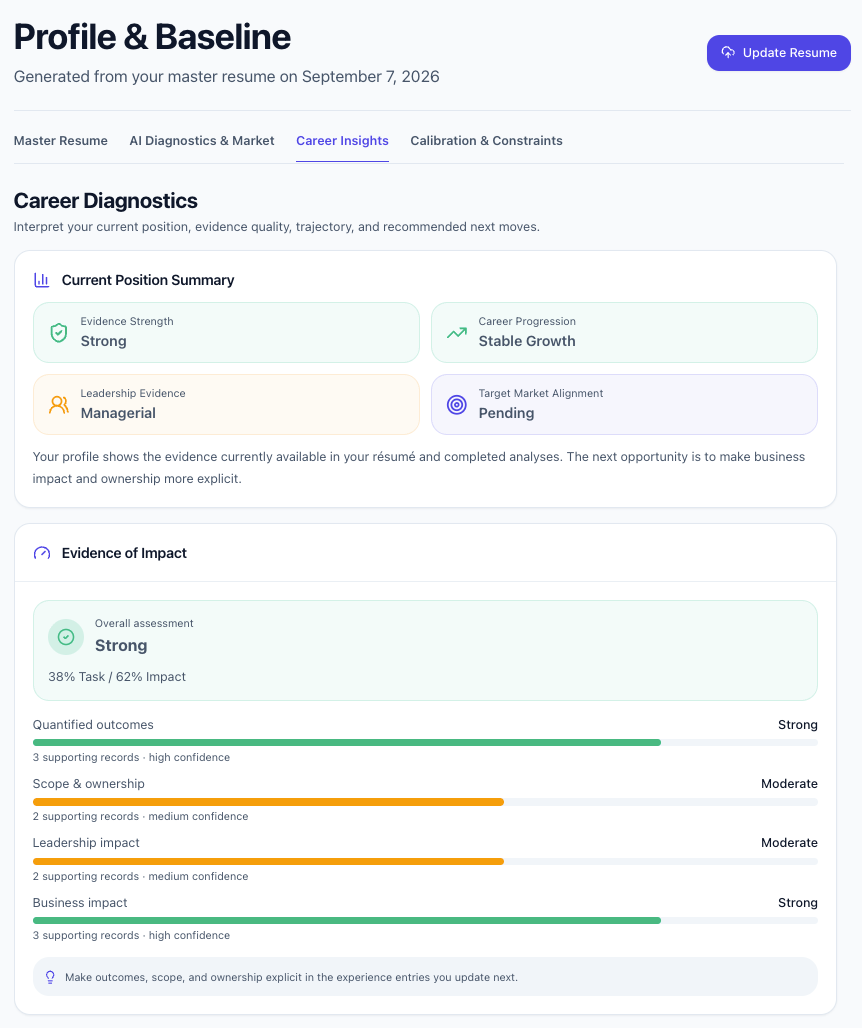
Clarity starts with understanding the profile you already have. Resume analysis can surface accomplishments, missing evidence, positioning weaknesses, and potential red flags. Job-opportunity analysis can then compare that profile with destination roles rather than leaving you to judge fit from a title alone.
A professional considering program management, consulting, and operational leadership could use the CareerGauge Chrome extension to capture structured job descriptions across all three categories. Instead of reacting to individual postings, the candidate can build a body of evidence: Which skills recur? Which requirements are genuinely common? Which gaps appear only occasionally? Which roles consistently align with the existing profile?
User initiated. CareerGauge only inspects the active page when you open the extension.
That creates Confidence grounded in data rather than positive thinking.
As applications begin, CareerGauge can help manage tailored application packets, interviews, contacts, events, follow-ups, and job-search scheduling. More importantly, patterns across multiple applications can reveal whether the strategy itself needs adjustment.
Ten applications with zero interviews may indicate positioning or targeting problems. Strong interview rates for program-management jobs but weak results for consulting roles are information. Repeated requests for one specific capability are evidence that targeted upskilling may be worthwhile.
That creates Control.
Career change after 40 should not be a leap from a secure identity into an unknown one. It can be run as a sequence of hypotheses:
What do I already know how to do?
Where does the market value it?
What evidence am I missing?
What is the smallest credible bridge?
What are employers actually telling me?
The professionals most likely to navigate the next decade successfully may not be those who predict perfectly which occupations AI will disrupt. The stronger position is to become good at career navigation itself: understanding your transferable value, recognizing adjacent opportunities, continually building relevant capabilities, and using market feedback to decide what comes next.
Your career after 40 is not a sunk cost.
It is capital. The task is to redeploy it intelligently.